
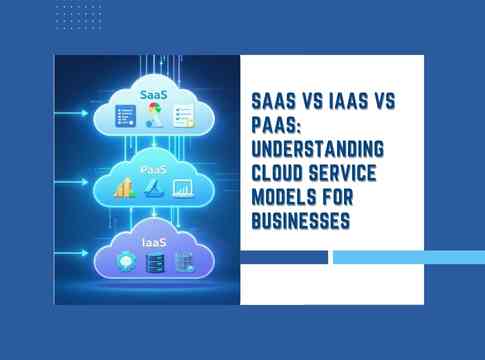
In the digital era, businesses increasingly rely on cloud computing to improve flexibility, reduce costs, and scale efficiently. Choosing the right cloud service model is critical, and understanding the differences between saas vs iaas vs paas helps organizations make informed decisions. Each model offers distinct benefits, caters to specific needs, and impacts the way businesses deploy and manage technology.
Cloud computing has revolutionized IT infrastructure by providing on-demand access to computing resources, applications, and platforms over the internet. SaaS, IaaS, and PaaS are the primary service models, each designed for different use cases and levels of control.
Understanding SaaS, IaaS, and PaaS
SaaS, or Software as a Service, delivers software applications over the internet. Businesses can access applications through a web browser without managing hardware, servers, or installation processes. SaaS simplifies software management, reduces upfront costs, and enables rapid deployment. Examples include email services, customer relationship management (CRM) tools, and productivity software. When comparing saas vs iaas vs paas, SaaS is typically the most user-friendly and requires minimal technical expertise from end-users.
IaaS, or Infrastructure as a Service, provides virtualized computing resources over the internet. It allows organizations to rent servers, storage, and networking components instead of investing in physical hardware. IaaS offers greater flexibility than SaaS because businesses have control over operating systems, applications, and storage. This makes IaaS ideal for companies that want scalable infrastructure without the complexity of hardware maintenance. When evaluating saas vs iaas vs paas, IaaS is often preferred by IT teams needing extensive customization and control.
PaaS, or Platform as a Service, sits between SaaS and IaaS by providing both infrastructure and development tools. PaaS enables developers to build, test, and deploy applications without managing the underlying hardware and software layers. It is particularly useful for organizations focused on application development, as it accelerates workflows, simplifies updates, and ensures smoother integration. Comparing saas vs iaas vs paas, PaaS offers a balance of flexibility and convenience for development teams.
Key Differences Between SaaS, IaaS, and PaaS
The main differences between SaaS, IaaS, and PaaS revolve around control, flexibility, and responsibility. SaaS provides ready-to-use software with minimal management, IaaS gives infrastructure control while offloading hardware responsibilities, and PaaS offers a platform for application development without managing underlying systems. Understanding these distinctions is crucial for choosing the right model based on business needs and technical capabilities.
Benefits of SaaS
SaaS offers several advantages for businesses. It reduces upfront costs since software is subscription-based, eliminates the need for installation, and allows employees to access applications from anywhere with an internet connection. SaaS also provides automatic updates and security management, which reduces IT overhead. For organizations looking for efficiency and ease of use, SaaS is often the go-to solution in the saas vs iaas vs paas discussion.
Benefits of IaaS
IaaS is ideal for businesses needing scalable infrastructure without investing heavily in physical hardware. It provides flexibility to configure operating systems and applications, supports disaster recovery solutions, and enables rapid scaling during peak demand. By renting virtualized resources, companies can optimize costs while maintaining control over their IT environment. When comparing saas vs iaas vs paas, IaaS is preferred by organizations requiring extensive customization.
Benefits of PaaS
PaaS simplifies application development by providing pre-configured environments, development frameworks, and integration tools. Developers can focus on coding and deployment rather than managing servers or software updates. PaaS also supports collaboration across teams and accelerates time-to-market for applications. In the saas vs iaas vs paas debate, PaaS strikes a balance between control and convenience for development-focused businesses.
How to Choose the Right Cloud Model
Selecting the right cloud model depends on business goals, technical expertise, and desired control. Companies that need ready-to-use software for everyday tasks may prefer SaaS. Organizations requiring flexible infrastructure with control over operating systems and applications often choose IaaS. For development teams aiming to build and deploy applications efficiently, PaaS provides an optimal solution. Evaluating these factors carefully ensures the chosen model aligns with business strategy and operational requirements.
Real-World Applications
SaaS is commonly used for CRM, email platforms, and office productivity suites. IaaS supports hosting websites, virtual machines, and storage-intensive applications. PaaS is leveraged for application development, API integration, and software testing. Understanding saas vs iaas vs paas helps organizations implement the right solution for each use case, maximizing efficiency and ROI.
Future Trends in Cloud Computing
Cloud services continue to evolve, with hybrid models combining elements of SaaS, IaaS, and PaaS. Businesses are increasingly adopting multi-cloud strategies to enhance redundancy, flexibility, and cost-effectiveness. Awareness of saas vs iaas vs paas enables organizations to stay ahead in adopting emerging cloud technologies while optimizing IT operations.
CFOInfoPro empowers finance leaders to make informed decisions by delivering valuable and practical insights.