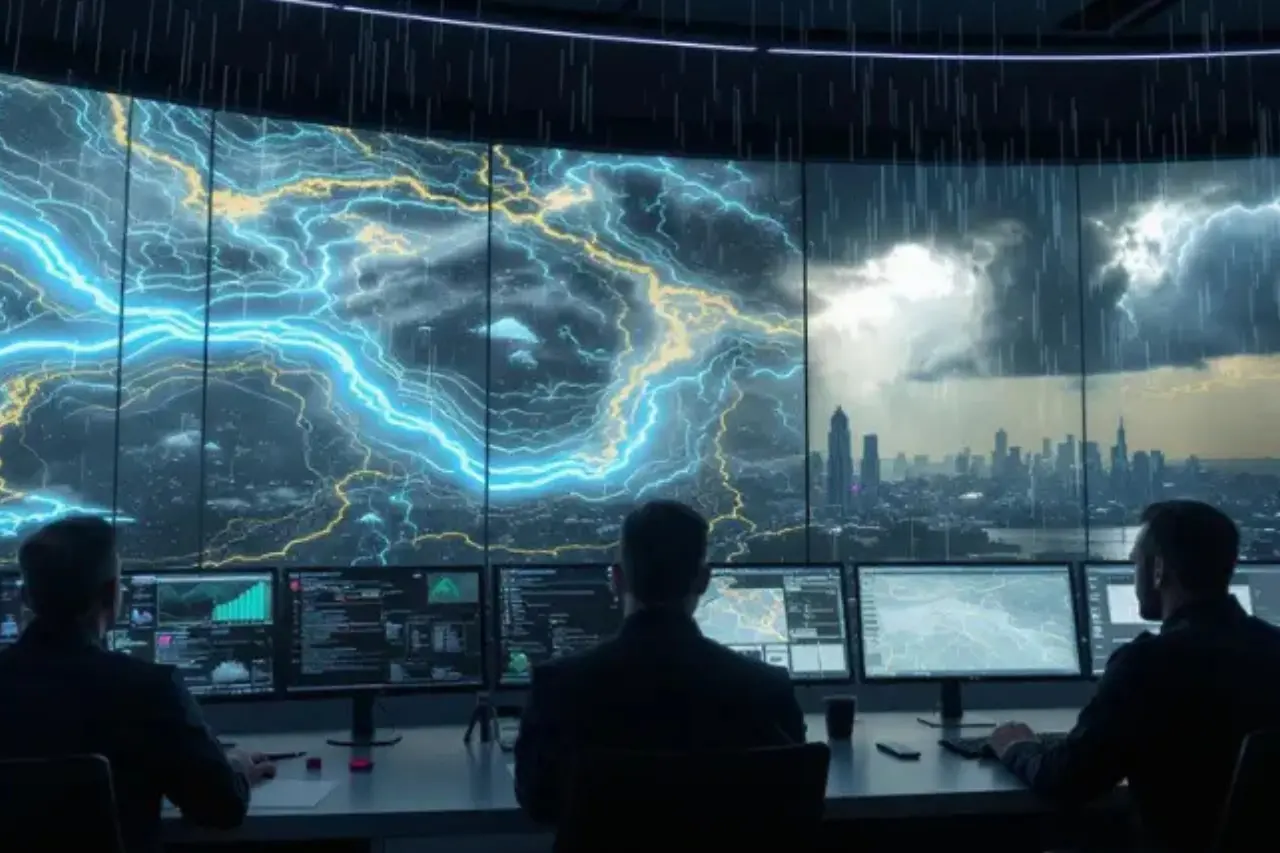
Google uses AI and old reports to predict flash floods as part of a growing effort to strengthen early warning systems for climate related disasters. This approach combines modern machine learning with historical weather data to improve forecasting accuracy and response time. As climate events become more unpredictable, such systems are becoming essential for governments and organizations worldwide.
Moreover, this development reflects how digital intelligence is reshaping disaster management. By analyzing past incidents alongside real time environmental signals, Google uses AI and old reports to predict flash floods with greater precision than traditional models. Consequently, this innovation is gaining attention across Technology insights and IT industry news communities.
How historical data strengthens prediction models
One of the key strengths of this system lies in its use of archived flood reports. Google uses AI and old reports to predict flash floods by feeding historical disaster records into advanced algorithms. These records include rainfall patterns, river overflow data, and geographic risk zones.
In addition, machine learning systems identify recurring patterns that may not be visible through conventional analysis. Therefore, when similar weather conditions begin to form, the system can trigger early alerts. This combination of memory based learning and predictive intelligence allows Google uses AI and old reports to predict flash floods in a more adaptive and scalable way.
Furthermore, this method ensures that regions with limited modern sensor infrastructure are still included in predictive coverage. As a result, even older data becomes a powerful asset in modern forecasting systems.
Role of artificial intelligence in real time forecasting
Artificial intelligence plays a central role in enhancing prediction speed and accuracy. Google uses AI and old reports to predict flash floods by training models that continuously learn from incoming weather data. These systems process satellite imagery, rainfall intensity, and river level changes to estimate flood risk.
In addition, AI systems are designed to improve over time. As new data enters the system, predictions become more refined and responsive. Consequently, Google uses AI and old reports to predict flash floods with increasing reliability across different geographic regions.
Transitioning from traditional forecasting methods, AI introduces automation and scale. This reduces human error while improving decision making for emergency response teams. Moreover, this innovation is influencing broader Finance industry updates as governments and insurers evaluate risk exposure using similar predictive technologies.
Impact on global disaster preparedness
The integration of AI into flood prediction is transforming how countries prepare for natural disasters. Google uses AI and old reports to predict flash floods, enabling faster alerts and more efficient evacuation planning. This is particularly valuable in regions prone to sudden rainfall and river overflow.
Additionally, emergency response teams can now allocate resources more effectively. Early warnings allow authorities to reduce damage and protect vulnerable communities. Therefore, Google uses AI and old reports to predict flash floods is not only a technological advancement but also a humanitarian tool.
Meanwhile, organizations studying HR trends and insights are observing how disaster readiness is influencing workforce planning. Companies operating in high risk regions are increasingly investing in remote response systems and digital monitoring tools.
Integration with modern data ecosystems
Modern forecasting systems rely on large scale data integration. Google uses AI and old reports to predict flash floods by combining cloud computing, geographic mapping, and sensor based inputs. This creates a unified ecosystem where multiple data sources work together.
Moreover, the system aligns with broader IT industry news trends focused on automation and predictive analytics. Businesses across sectors are exploring similar models to improve operational resilience. As a result, Google uses AI and old reports to predict flash floods is becoming a reference point for innovation in environmental intelligence.
In addition, Sales strategies and research teams are studying how predictive alerts can reduce business disruption. Marketing trends analysis also shows rising public interest in climate safety technologies, especially those powered by artificial intelligence.
Challenges in predictive flood technology
Despite its progress, the system faces several challenges. Google uses AI and old reports to predict flash floods, but accuracy still depends on the quality and completeness of historical data. In some regions, outdated or incomplete records can limit prediction reliability.
Furthermore, extreme weather patterns influenced by climate change may not always align with historical trends. This introduces uncertainty into the model. Even so, Google uses AI and old reports to predict flash floods continues to improve as more real time data becomes available.
Another challenge lies in infrastructure readiness. While predictions may be accurate, effective response depends on communication systems and local emergency planning. Therefore, technological advancement must be matched with strong on ground coordination.
Future direction of AI based environmental forecasting
Looking ahead, Google uses AI and old reports to predict flash floods represents a foundation for broader environmental intelligence systems. Future models are expected to incorporate more real time satellite data, IoT sensors, and advanced simulation techniques.
In addition, integration with global climate monitoring networks will further enhance accuracy. This evolution will likely expand into other areas such as drought prediction, wildfire tracking, and urban drainage planning. Consequently, Google uses AI and old reports to predict flash floods may serve as a blueprint for future disaster prediction systems.
Moreover, continuous improvements in machine learning will enable faster adaptation to changing environmental conditions. This will strengthen global resilience against unpredictable natural events.
Insights for practical understanding and application
The development of AI powered flood prediction highlights the importance of combining historical knowledge with modern analytics. Google uses AI and old reports to predict flash floods by transforming archived information into actionable intelligence. This demonstrates how legacy data can still drive innovation in a digital first world.
Organizations can learn from this approach by investing in data preservation and analytics infrastructure. In addition, collaboration between public agencies and technology companies will be essential for scaling such systems globally. As industries continue to evolve, Technology insights and Finance industry updates will increasingly reflect the value of predictive intelligence in risk management.
Ultimately, the success of such systems depends on continuous improvement, data accuracy, and real world application. Google uses AI and old reports to predict flash floods shows how technology can bridge the gap between historical knowledge and future preparedness.
For deeper industry analysis and strategic intelligence on emerging technologies, connect with CFOInfoPro and explore how data driven innovation is reshaping global risk and decision making frameworks.